By Morgan Thomas, Policy Associate
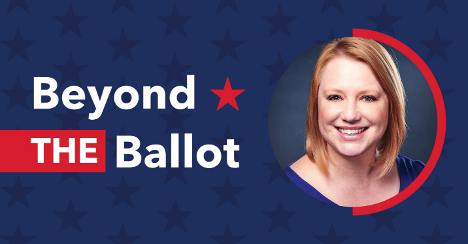
Colorado Deputy Elections Director Hilary Rudy is no stranger to elections. Growing up, Rudy’s mother worked as an election official at the county level for 26 years. Although she was exposed to elections from a young age, Rudy had no interest in pursuing a career like her mother’s. She was more interested in pursuing a career in law. However, while attending law school, Rudy realized she wasn’t fully satisfied with her current studies. In 2005, after a recommendation from her mother, Rudy interned with the Colorado Secretary of State’s Office and discovered her love for elections.
Upon completing law school, Rudy stayed with the Secretary of State’s Office and began working full-time as a legal analyst in 2006. In the spring of 2008, she became a score legal analyst, where she focused on migrating counties to a new statewide voter registration system, which was set to roll out before the 2008 U.S. presidential election.
“It was a pretty big shift,” Rudy said. “Before the score system, there were 64 independent systems that the counties used. Moving 64 counties to a single centralized system was a really significant change heading into a presidential election.”
Fast-forward to today. Rudy has since stayed with the Colorado Secretary of State’s Office and now serves as the deputy elections director. Her role entails overseeing the various elections teams that provide direct support and oversight to Colorado voters across all 64 counties. Each team is active at different points throughout the election cycle, which keeps Rudy busy.
As deputy director, Rudy is also tasked with implementing training programs throughout the year.
“Training is definitely one thing I love personally,” Rudy said. “I really enjoy working with our trainers to develop and deliver content to help our election administrators do their jobs.”
The Colorado Secretary of State’s Office coordinates roughly 18 asynchronous online training classes on topics such as issuing provisional ballots, accommodating military and overseas voters and canvassing in elections. In addition to online training, Colorado also offers in-person regional training twice a year, where counties can come together to discuss complex issues like contingency planning.
Given her long tenure in elections, Rudy has been responsible for implementing many procedural changes resulting from federal legislation, most notably the Help America Vote Act of 2002. She also spoke highly about the improvement in ballot access for voters due to many state-level changes that she’s observed over the past decade.
“We’ve seen consistent changes in Colorado at the state level over the years that are really focused on making elections accessible for voters,” Rudy said. “For us in Colorado, that meant a shift toward mail ballot delivery since 2013. We’ve also seen changes in voter registration processes, such as moving from a 30-day hard deadline to no local durational residency requirements, same-day voter registration and a real-time statewide voter registration system.”
This progress, however, has not come without any setbacks. Like many states, Colorado has also been impacted by the rise of misinformation and disinformation surrounding elections. In addition to providing accurate and up-to-date answers to FAQs on the state’s election website, the Secretary of State’s Office runs consistent media messaging alongside local election offices.
“There’s a lot of disinformation about election processes, eligibility and how elections are conducted, and the challenge has been how to ensure voters are looking at trusted sources for information,” Rudy said. “I think speaking with unity and providing accurate information is really important right now. Getting national leaders and election officials to be that unified, trusted point of information would help build that trust in elections.”
Public scrutiny of elections has really taken a toll on election offices across the country. In Colorado, Rudy noted a significant uptake in office phone calls from frustrated voters as well as threats directed toward the secretary of state. The nature and volume of these threats has caused her to worry about her own safety.
“We monitor threats regularly, but I’ve testified in some pretty high-profile cases on behalf of our office, and I’ve seen some social media chatter about myself,” Rudy said. “It made me think about my own personal safety a little bit more. I’m not going to let any of that back me down, and I’m fortunate that I haven’t faced the kinds of threats that many of my colleagues across the country have faced.”
Nevertheless, Rudy is “committed to transparent and accurate elections” even amidst public scrutiny. “I believe in elections, and I believe in democracy,” she said.
Enhanced public scrutiny of election officials has raised concerns and fear in election officials across the country to the extent that many seasoned election officials have stepped down. However, Colorado has not had a significant retention problem in the last four years. According to Rudy, the turnover she has seen has mostly resulted from term limits or retirement rather than turnover due to scrutiny.
“We’ve had a little bit of turnover here in the secretary’s office, but nothing significant,” Rudy said. “We have a great depth of election experience in our office. In the county offices, we see some turnover as well, but here in Colorado, we’re seeing more systematic turnover to deal with term limits and regular retirements. Overall, the turnover is consistent with what we would expect, even in the county offices.”
Retaining seasoned election officials is especially important when serving a large population of military and overseas citizen voters, also referred to as UOCAVA voters. Colorado has roughly 40,000 UOCAVA voters and that number is steadily rising. Even with the help of subject matter experts, reaching UOCAVA voters remains a challenge in Colorado and across many states.
“Most of our UOCAVA voters are well outside of Colorado, and finding the right communication method to ensure they know they are eligible to vote in non-federal elections has been challenging,” Rudy said. “We’ve found that there seems to be a small education gap between what our UOCAVA voters think they’re eligible for and what they’re actually eligible for.”
Communication is critical when trying to reach UOCAVA voters. Rudy noted that her office is constantly seeking out innovative ways to get accurate and timely information about upcoming elections to overseas voters. She has found that a combined approach of social media, mail and email has been most effective. According to Rudy, Colorado counties reach out to their UOCAVA voters at least once a year before an upcoming election to ensure they know an election is coming up and confirm their location is still the same. The Secretary of State’s Office also sends emails to remind UOCAVA voters about upcoming ballot delivery timelines and instructions before an election.
“One thing in Colorado that we’ve really focused on is how do we get that ballot to [UOCAVA voters] quickly and ensure they have the information they need to participate,” Rudy said. “I think our online ballot delivery system has been very popular over the years, and we expect to continue to see pretty high use of that system.
In addition to UOCAVA outreach, Colorado is actively working to make voting more accessible for urban and rural voters. Overall, Colorado’s vote-by-mail system works well for most voters. However, some communities have lower voter registration and turnout rates than others. One such community is the city and county of Denver, which “deploys community leaders to talk about voter registration and working directly with the community to discuss how to receive your ballots.”
Election officials in Denver County also sought to improve voter participation by expanding ballot drop boxes and establishing vote centers. However, in one neighborhood, Denver County lacked the proper infrastructure to do so.
“[Election officials from] Denver County, Adams County and Arapahoe County worked together to co-locate a tri-county vote center and a tri-branded drop box in the last election,” Rudy said. “So even with a voting model that generally works pretty well for most voters, we had to think about making sure the infrastructure is also there for voters to have the option to utilize a drop box to drop off their ballot.”
2020 was a shock to election offices across the country. While adjustments were made in every office, Colorado’s adjustments looked different. During the 2020 election, many states made pandemic-related changes to election procedures to ensure voting access; however, Colorado’s adjustments sought to protect election officials.
“Colorado was well positioned going into 2020 because we were already an all-mail ballot state. We didn’t need to make any big changes in conducting elections. However, we did make many changes to protect the election officials who were working during the election,” said Rudy.
Throughout the pandemic, Colorado required election officials and poll workers to wear sneeze guards and face masks in accordance with public health guidance. Many staff members also transitioned to remote or hybrid work arrangements. Although the pandemic has ended, these adjustments have remained in place.
“In the State Office, we’ve continued a hybrid work model because we found that it worked really well for our team during that period, and it may be one of the reasons we have high retention in the workspace,” said Rudy.
If there’s one thing that 2020 taught election officials, it is the importance of preparing for the unexpected. Heading into a federal election year, Rudy and her colleagues have developed contingency plans not only for weather-related events, but also physical threats. For example, in 2023 election officials in several states received letters containing fentanyl. Although briefly touching fentanyl cannot cause an overdose, many of these envelopes contained threatening messages. These letters have caused Rudy and her colleagues to reevaluate how they plan for and respond to such threats.
Rudy and many of her colleagues have persevered despite many challenges in recent years through flexibility and a passion for democracy. When asked about her highlights from working in elections, Rudy noted working with interns and mentorship as her top highlights.
“One thing that I am proud of is working with interns. I get to mentor future leaders in elections and I’m very proud of that.”
When Rudy is not working or mentoring, she enjoys playing softball and lifting weights. Although her work consumes most of her time, Rudy’s positive work ethic is fueled by her sincere admiration for elections and service. When asked about her favorite part about working in elections, Rudy stated, “I come from a long line of opinionated women, and I was told at a young age, if you don’t say it, nobody hears it. Your opinion only matters if you use it. So, I think my favorite part about working in elections is that one person, one vote, can change an election. And that’s powerful.”